Govt. accreditedEMC Kerala / BEE / GEDAEnergy · Safety · Sustainabilitysince 2008
+91 73561 11990info@athulenergy.com
Athul Energy Consultants
Home
About
Company Profile & StoryWho we are, BEE & EMC empanelments, and 15+ years of audit history since 2008.Our Engineering TeamBEE Accredited Energy Auditors, CEA Safety Inspectors, FLIR Thermographers & Green specialists.
Services
Energy AuditsDetailed electrical, thermal, PAT M&V and mandatory BEE/EMC statutory assessments.Safety AuditsCEA regulation compliance, arc flash analysis, fire safety and IS 14489 hazard reviews.Thermography & SurveysFLIR Level-II thermal scanning, ultrasonic flow testing and IS 3043 earthing studies.Compliance & NAACGRIHA green building audits, NAAC criteria 7, NABH hospital safety and ISO 50001.Technical TrainingBEE exam coaching, industrial electrical safety, LOTO protocols and engineer workshops.All 30+ Services HubExplore complete directory with live keyword search, standards and instrument specs.
30+ Disciplines · BEE Accredited & EMC EmpanelledBrowse full directory
GalleryBlogContact
Request an audit
Home
GalleryBlogContact
Call usRequest an audit
Athul Energy Consultants

BEE accredited energy audit and electrical safety consultants serving industrial, commercial and institutional sites across Kerala since 2008.

BEE AEA-0275EMC KeralaGEDAMEDA
+91 73561 11990Email us

Company

  • About us
  • Engineering team
  • Downloads
  • Gallery
  • News & events
  • Contact

Services

  • Energy Audits
  • Safety Audits
  • Thermography & Surveys
  • Compliance & NAAC
  • Technical Training
  • All 30 services

Head office

Capital Legend Building,
Korappath Lane, Thrissur North,
Kerala 680020

+91 73561 11990

info@athulenergy.com

© 2026 Athul Energy Consultants Pvt. Ltd. All rights reserved.

BEE accredited · Est. 2008Request an audit
HomeBlogBEE Energy AuditsComplete Guide to Mandatory BEE Energy Audits for Designated Consumers (PAT Scheme)
BEE Energy AuditsOctober 28, 2026•8 min read

Complete Guide to Mandatory BEE Energy Audits for Designated Consumers (PAT Scheme)

A technical walkthrough for plant managers and electrical heads on compliance under the Energy Conservation Act 2001, Form 1 filings, SEC baseline benchmarking, and ESCerts trading.

SA
Santhosh A.Lead BEE Accredited Energy Auditor (AEA-0275)
AEA-0275 / EmAEA 091
Complete Guide to Mandatory BEE Energy Audits for Designated Consumers (PAT Scheme)
Field Study Dossier · Athul Energy ConsultantsNABL Calibrated Instrumentation
Key Statutory Takeaways for Plant Managers
  • Mandatory compliance intervals must be adhered to avoid Section 26 fines under the Energy Conservation Act 2001.
  • All baseline SEC and electrical safety reports require direct sign-off by a BEE Accredited Energy Auditor.
  • Third-party verified NABL instrument calibration is legally required for Form 1 and Form A/B verification.

1. Legal Framework: EC Act 2001 & PAT Cycles

Under Section 14(a) of the Energy Conservation Act (EC Act) 2001, the Central Government has mandated that all commercial facilities and industrial plants falling within designated energy-intensive sectors and exceeding prescribed threshold consumption levels must undergo an official Mandatory Energy Audit by a Bureau of Energy Efficiency (BEE) Accredited Energy Auditor (AEA).

The Perform, Achieve and Trade (PAT) scheme represents India's flagship market-based mechanism under the National Mission for Enhanced Energy Efficiency (NMEEE). It operates in 3-year rolling cycles requiring each designated consumer to achieve specific reductions in their Specific Energy Consumption (SEC):

Statutory Citation:
*"Every Designated Consumer shall get energy audits conducted by an accredited energy auditor in the manner and intervals specified under BEE (Manner and Intervals of Time for Conduct of Energy Audit) Regulations."*

---

2. Designated Consumer (DC) Energy Thresholds

Industrial facilities operating in the following sectors are categorized as Designated Consumers when their annual total energy consumption equals or exceeds these statutory thresholds (measured in Metric Tonnes of Oil Equivalent - MTOE):

Industrial SectorMinimum Threshold (MTOE / Year)Primary Energy Metrics

Thermal Power Plants (Coal/Gas)30,000 MTOENet Station Heat Rate (kCal/kWh)
Cement Mills30,000 MTOESpecific Power (kWh/t) & Heat (kCal/kg clinker)
Iron & Steel30,000 MTOEGiga Calories per Tonne of Crude Steel
Textile (Composite)3,000 MTOEkWh per Kilogram of Finished Fabric
Pulp & Paper30,000 MTOETonnes of Steam & kWh per Tonne of Paper
Commercial Buildings (DISCOM)100 kW / 120 kVA connectedEnergy Performance Index (kWh/sq.m/yr)

---

3. The 4-Phase Statutory Audit Protocol

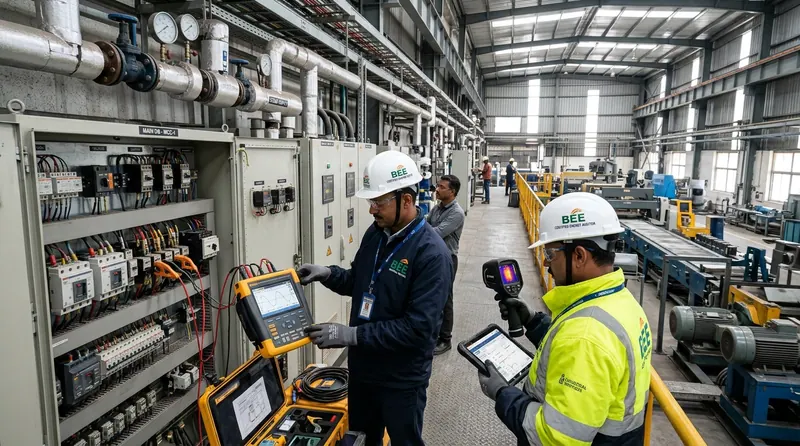
When Athul Energy's team of Accredited Energy Auditors executes a mandatory audit, the process is structured into four non-negotiable engineering phases:

Phase 1: Pre-Audit Single-Line & Billing Harmonization

  • Collation of historical 12-to-36 months utility bills (HT power, natural gas, biomass, diesel, coal).
  • Review of Single-Line Diagrams (SLD), motor control centers (MCC), and process piping & instrumentation diagrams (P&ID).
  • Establishment of the baseline plant operating hours, production volume, and sub-metering reconciliation.
  • Phase 2: Live On-Site Precision Field Logging

  • Deployment of Class-A true RMS power quality analyzers across incoming HT 11kV/33kV/66kV transformers.
  • Direct non-contact transit-time ultrasonic flow measurement on chilled water and condenser water circuits.
  • Flue gas combustion analysis (O2%, CO ppm, excess air ratio, stack temperature) on all utility boilers and thermic fluid heaters.
  • Level-II infrared thermography on all LT distribution switchboards to spot phase imbalances and connection resistance.
  • Phase 3: Mass & Energy Balance Mathematical Modeling

  • Calculation of distribution transformer copper and core losses.
  • Specific Energy Consumption (SEC) derivation for each distinct production line against BEE benchmarks.
  • Compressed air network leakage quantification via pressure-decay testing.
  • Phase 4: Energy Conservation Measures (ECM) & Payback Roadmap

  • Categorization of identified savings into Zero-Cost (operational tweaks), Low-Cost (insulation, VFD additions), and Capital Retrofits (waste heat recovery, boiler burner upgrades).
  • Financial metrics including Simple Payback Period, Net Present Value (NPV), and Internal Rate of Return (IRR).
  • ---

    4. Form 1, Form A/B Filing & Statutory Reporting

    Once field measurements and modeling are completed, the Designated Consumer must submit official compliance documentation to both the State Designated Agency (SDA) (such as EMC Kerala or MEDA) and the Bureau of Energy Efficiency (BEE):

    1. Form 1: Annual energy consumption details, fuel inventory, production logs, and specific energy consumption metrics. Must be submitted within 3 months of the financial year close. 2. Form A (Audit Report Certification): Official sign-off by the BEE Accredited Energy Auditor certifying that the audit was conducted according to statutory codes. 3. Form B (Action Plan Implementation): Details of the energy conservation recommendations implemented by the DC and verified savings achieved.

    Failure to submit Form 1 or conduct audits within prescribed intervals attracts statutory penalties under Section 26 of the Energy Conservation Act, with daily fines for ongoing non-compliance.

    ---

    5. Monetizing Compliance via ESCerts (Trading)

    One of the most powerful financial incentives in the PAT framework is the Energy Saving Certificate (ESCert) mechanism:

  • If a Designated Consumer achieves energy savings exceeding its statutory SEC reduction target, BEE issues tradeable ESCerts (where 1 ESCert = 1 MTOE of energy saved).
  • These ESCerts can be traded on national power exchanges (IEX and PXIL) to other Designated Consumers who have fallen short of their target.
  • For high-performing plants, ESCerts generate substantial recurring financial returns that offset the costs of plant energy-saving retrofits.
  • ---

    6. Plant Manager Audit Readiness Checklist

    To ensure your facility is prepared for an accredited BEE audit with zero friction, keep the following documentation organized:

  • [ ] Complete 12-month HT electricity bills, maximum demand charts, and TOD tariff breakdown.
  • [ ] Updated Single-Line Diagram (SLD) reflecting all DG sets, transformers, and capacitor banks.
  • [ ] Fuel purchase invoices, calorific value test reports (GCV/NCV for coal, furnace oil, diesel, or biomass).
  • [ ] Daily production logs matching the corresponding 12-month billing period.
  • [ ] Chiller, boiler, and air compressor manufacturer performance data sheets.
  • [ ] Previous energy audit reports and records of implemented conservation measures.
  • Partner with Accredited Auditors

    Athul Energy Consultants Pvt. Ltd. is an empanelled Class-A Accredited Energy Auditing firm with credentials across BEE, EMC Kerala, GEDA, and MEDA. Contact our accredited lead auditors at +91 73561 11990 or submit your plant details for a formal statutory audit proposal.

    Related Engineering Tags:
    #BEE Audit#PAT Scheme#Designated Consumer#Form 1#Energy Conservation Act
    SA
    Article Author & Technical Auditor

    Santhosh A.

    Lead BEE Accredited Energy Auditor (AEA-0275)

    Founder & Managing Director of Athul Energy Consultants Pvt. Ltd. with over 25 years of field experience conducting mandatory statutory audits across heavy industrial sectors in India.

    Table of Contents
    1. Legal Framework: EC Act 2001 & PAT Cycles2. Designated Consumer (DC) Energy Thresholds3. The 4-Phase Statutory Audit Protocol4. Form 1, Form A/B Filing & Statutory Reporting5. Monetizing Compliance via ESCerts (Trading)6. Plant Manager Audit Readiness Checklist
    Empanelled Firm

    Schedule a Facility Audit

    Need assistance with BEE statutory audits, electrical safety sign-offs, or power quality mitigation?

    Request Audit Scoping+91 73561 11990
    NDA Assured:Plant single-line diagrams and utility bills are handled strictly under non-disclosure agreements.