Govt. accreditedEMC Kerala / BEE / GEDAEnergy · Safety · Sustainabilitysince 2008
+91 73561 11990info@athulenergy.com
Athul Energy Consultants
Home
About
Company Profile & StoryWho we are, BEE & EMC empanelments, and 15+ years of audit history since 2008.Our Engineering TeamBEE Accredited Energy Auditors, CEA Safety Inspectors, FLIR Thermographers & Green specialists.
Services
Energy AuditsDetailed electrical, thermal, PAT M&V and mandatory BEE/EMC statutory assessments.Safety AuditsCEA regulation compliance, arc flash analysis, fire safety and IS 14489 hazard reviews.Thermography & SurveysFLIR Level-II thermal scanning, ultrasonic flow testing and IS 3043 earthing studies.Compliance & NAACGRIHA green building audits, NAAC criteria 7, NABH hospital safety and ISO 50001.Technical TrainingBEE exam coaching, industrial electrical safety, LOTO protocols and engineer workshops.All 30+ Services HubExplore complete directory with live keyword search, standards and instrument specs.
30+ Disciplines · BEE Accredited & EMC EmpanelledBrowse full directory
GalleryBlogContact
Request an audit
Home
GalleryBlogContact
Call usRequest an audit
Athul Energy Consultants

BEE accredited energy audit and electrical safety consultants serving industrial, commercial and institutional sites across Kerala since 2008.

BEE AEA-0275EMC KeralaGEDAMEDA
+91 73561 11990Email us

Company

  • About us
  • Engineering team
  • Downloads
  • Gallery
  • News & events
  • Contact

Services

  • Energy Audits
  • Safety Audits
  • Thermography & Surveys
  • Compliance & NAAC
  • Technical Training
  • All 30 services

Head office

Capital Legend Building,
Korappath Lane, Thrissur North,
Kerala 680020

+91 73561 11990

info@athulenergy.com

© 2026 Athul Energy Consultants Pvt. Ltd. All rights reserved.

BEE accredited · Est. 2008Request an audit
HomeBlogBoiler & Steam SystemsIndustrial Boiler & Steam System Efficiency: 5 High-ROI Energy Conservation Measures (ECMs)
Boiler & Steam SystemsSeptember 14, 2026•7 min read

Industrial Boiler & Steam System Efficiency: 5 High-ROI Energy Conservation Measures (ECMs)

A thermal engineering guide to maximizing boiler direct/indirect efficiency, excess air tuning, blowdown waste heat recovery, and steam trap population surveys.

AK
Ashok K. M. P.Technical Director & Senior Energy Consultant
Certified Energy Manager
Industrial Boiler & Steam System Efficiency: 5 High-ROI Energy Conservation Measures (ECMs)
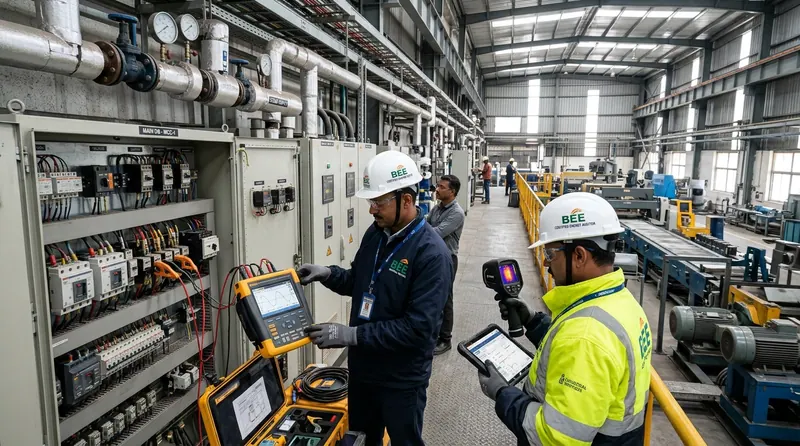
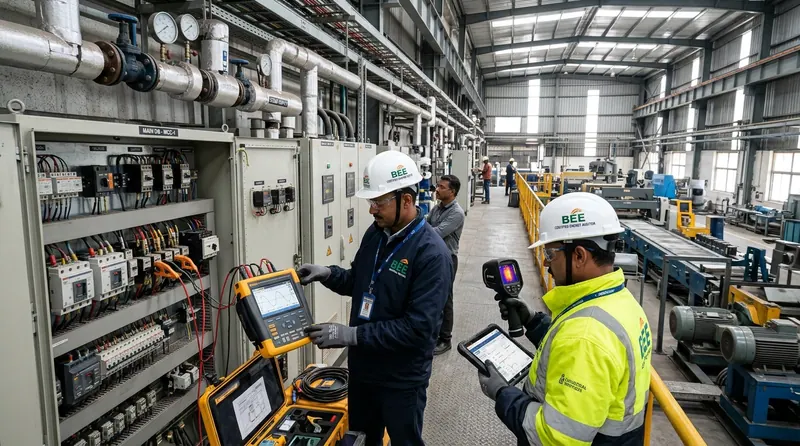
Field Study Dossier · Athul Energy ConsultantsNABL Calibrated Instrumentation
Key Statutory Takeaways for Plant Managers
  • Mandatory compliance intervals must be adhered to avoid Section 26 fines under the Energy Conservation Act 2001.
  • All baseline SEC and electrical safety reports require direct sign-off by a BEE Accredited Energy Auditor.
  • Third-party verified NABL instrument calibration is legally required for Form 1 and Form A/B verification.

1. Understanding Boiler Heat Losses (BS 845 / ASME PTC 4)

In process industries—such as food processing, chemicals, rubber, textiles, and pharmaceuticals—fuel used in boilers represents between 40% and 70% of total plant energy expenditure.

While direct boiler efficiency provides an operational estimate ($ ext{Heat Output} / ext{Heat Input}$), a thorough thermal audit utilizes the Indirect Heat Loss Method to quantify exact energy loss channels:

  • Dry flue gas stack loss ($L_1$, typically 10% to 25%).
  • Loss due to hydrogen in fuel forming water vapor ($L_2$, 4% to 8%).
  • Moisture in fuel and combustion air ($L_3$ & $L_4$).
  • Unburnt fuel losses in ash / incomplete combustion ($L_5$).
  • Surface radiation and convection losses ($L_6$, 1% to 3%).
  • ---

    2. ECM 1: Combustion Excess Air Tuning

    For complete fuel combustion, theoretical stoichiometric air is insufficient; extra air must be provided. However, too much excess air carries valuable heat straight out of the chimney stack:

  • Every 15% reduction in excess air or 1% decrease in flue gas $O_2$ improves overall boiler thermal efficiency by approximately 0.5% to 1.0%.
  • Ideal Flue Gas Oxygen Targets:
  • - Natural Gas: 2.0% to 3.0% $O_2$ (approx 10% to 15% excess air). - Light Diesel Oil (LDO) / Furnace Oil: 3.0% to 4.5% $O_2$ (15% to 25% excess air). - Coal / Briquette / Biomass: 4.5% to 6.5% $O_2$ (25% to 40% excess air).

    Installing automated trim oxygen sensors with modulating variable-speed combustion air fans typically pays back in under 4 to 6 months.

    ---

    3. ECM 2: Flue Gas Economizers & Air Pre-heaters

    Flue gas temperatures leaving standard industrial boilers often exceed 220°C to 280°C. That represents hundreds of thousands of BTUs vented to the atmosphere daily.

  • Rule of Thumb: Every 22°C drop in flue gas temperature achieved by preheating boiler feedwater yields a 1% fuel savings.
  • Installing an exhaust gas economizer to heat feedwater from 30°C to 80°C regularly achieves 4% to 7% overall fuel reduction.
  • ---

    4. ECM 3: Automatic TDS Blowdown & Heat Recovery

    To prevent scaling and dissolved solids buildup, boiler water is continuously purged (blowdown). Manual blowdown is notoriously inefficient—either over-purging (wasting hot treated water) or under-purging (scaling boiler tubes).

  • Implementing an Automatic Total Dissolved Solids (TDS) Blowdown System maintains precise conductivity levels.
  • Passing continuous blowdown water through a flash vessel and heat exchanger recovers flash steam and preheats make-up water, turning a major thermal loss into usable energy.
  • ---

    5. ECM 4: Eliminating Steam Trap Failures

    In unmonitored industrial steam networks, between 20% and 35% of all steam traps are either stuck open (leaking live steam) or plugged cold (waterlogged):

  • A single 15mm thermodynamic steam trap blowing open at 8 bar(g) leaks approximately 18 kg of live steam per hour.
  • Running 8,000 hours per year, this single failed trap wastes over 144 tonnes of steam annually, costing upwards of ₹3,50,000 in wasted fuel.
  • Ultrasonic and thermographic testing of 100% of the trap population identifies leaking traps for immediate rebuild or replacement.
  • ---

    6. ECM 5: Pipeline Insulation & Condensate Return

  • Insulating Bare Valves and Flanges: An uninsulated 4-inch gate valve operating at 170°C loses as much heat as 3 meters of bare pipe, costing over ₹25,000 annually. Removable thermal insulation jackets provide an instant 60-day ROI.
  • Maximizing Condensate Return: Every 6°C increase in boiler feedwater temperature achieved by returning pure, hot condensate saves 1% of fuel and drastically reduces chemical treatment costs.
  • Athul Energy provides complete thermal audits, flue gas logging, and steam network optimization.
    Related Engineering Tags:
    #Boiler Efficiency#Steam Traps#Waste Heat Recovery#Thermal Audit#ASME PTC 4
    AK
    Article Author & Technical Auditor

    Ashok K. M. P.

    Technical Director & Senior Energy Consultant

    Thermal systems specialist with 22 years of experience optimizing boiler plants, steam networks, and waste heat recovery systems in process manufacturing.

    Related Technical Guides

    View all insights →
    Complete Guide to Mandatory BEE Energy Audits for Designated Consumers (PAT Scheme)
    BEE Energy Audits
    8 min read
    BEE Energy Audits
    Oct 28, 2026

    Complete Guide to Mandatory BEE Energy Audits for Designated Consumers (PAT Scheme)

    A technical walkthrough for plant managers and electrical heads on compliance under the Energy Conservation Act 2001, Form 1 filings, SEC baseline benchmarking, and ESCerts trading.

    Santhosh A.•Oct 28
    SA
    Santhosh A.Lead BEE Accredited Energy Auditor (AEA-0275)
    Read Guide
    Table of Contents
    1. Understanding Boiler Heat Losses (BS 845 / ASME PTC 4)2. ECM 1: Combustion Excess Air Tuning3. ECM 2: Flue Gas Economizers & Air Pre-heaters4. ECM 3: Automatic TDS Blowdown & Heat Recovery5. ECM 4: Eliminating Steam Trap Failures6. ECM 5: Pipeline Insulation & Condensate Return
    Empanelled Firm

    Schedule a Facility Audit

    Need assistance with BEE statutory audits, electrical safety sign-offs, or power quality mitigation?

    Request Audit Scoping+91 73561 11990
    NDA Assured:Plant single-line diagrams and utility bills are handled strictly under non-disclosure agreements.