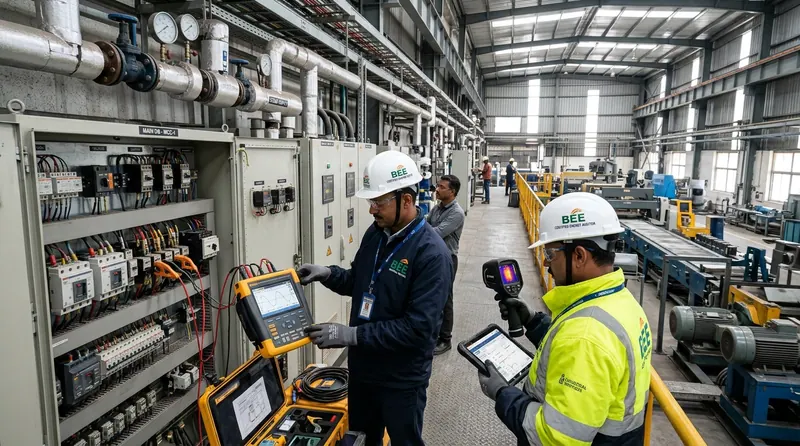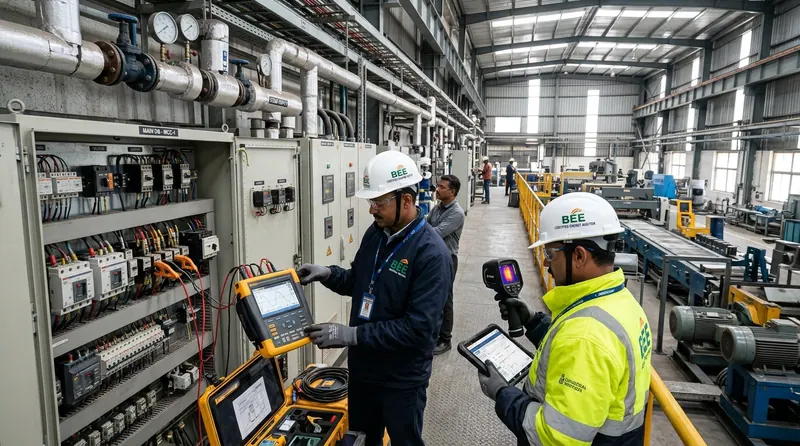
1. What are Harmonics and Why Do They Occur?
In a balanced, linear AC power network, current and voltage maintain a clean 50 Hz sinusoidal waveform. However, modern industrial facilities rely heavily on non-linear electrical loads:
These devices draw current in abrupt pulses rather than smooth waves, generating harmonic frequencies that are integer multiples of the fundamental 50 Hz frequency (3rd = 150 Hz, 5th = 250 Hz, 7th = 350 Hz, 11th = 550 Hz).
---
2. The Hidden Cost of High THD in Plants
Excessive harmonic distortion introduces severe operational and financial hazards: 1. Transformer Overheating & K-Factor Derating: Eddy current losses in transformer iron cores scale with the square of frequency ($f^2$), causing transformers to overheat even when running at 70% rated kVA load. 2. Neutral Conductor Overheating: Triplen harmonics (3rd, 9th, 15th) do not cancel out at the neutral point; they add arithmetically, causing neutral currents to exceed phase currents and burning neutral cables. 3. Capacitor Bank Explosions: Shunt power factor capacitors offer low impedance at high frequencies ($X_c = 1 / 2pi fC$), drawing harmonic currents that cause bulging, insulation failure, and catastrophic resonance. 4. Nuisance Breaker Tripping: Electronic trip units miscalculate true RMS values, causing unexpected factory blackouts.
---
3. IEEE 519-2022 Statutory Voltage & Current Limits
Under IEEE 519-2022, the maximum allowable Total Harmonic Distortion at the Point of Common Coupling (PCC) depends on the system voltage and the plant's Short Circuit Ratio ($I_{sc} / I_L$):
Voltage Harmonic Limits at PCC:
State electricity regulatory commissions (SERCs) across India have begun enforcing strict penalties or disconnection notices for industrial facilities exceeding prescribed harmonic distortion limits at the utility metering boundary.
---
4. Passive Detuned vs. Active Harmonic Filters
---
5. Sizing Active Harmonic Filters Correctly
To size an AHF properly without overpaying or leaving harmonic currents unmitigated: 1. Conduct a continuous 24-to-72 hour Class-A power quality log across full production cycles. 2. Determine the fundamental load current ($I_1$) and the 5th, 7th, 11th, and 13th harmonic currents ($I_h$). 3. Calculate the required harmonic compensation current: $$I_{AHF} = sqrt{I_5^2 + I_7^2 + I_{11}^2 + I_{13}^2} imes 1.25 ext{ (Safety Margin)}$$ 4. Ensure the selected unit supports simultaneous dynamic reactive power (kVAr) compensation and phase unbalance correction.
Athul Energy provides complete Class-A power quality logging and third-party verified AHF sizing reports.